

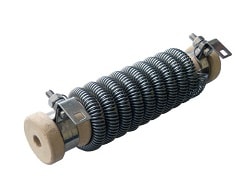
 [/vc_column_text][/vc_tab][vc_tab icon=”moon-stackoverflow” title=”Edgewound” tab_id=”1402323063-2-54″][vc_column_text]Edgewound resistive elements are strip type elements, essentially a stainless steel tape wound on tubular porcelain insulators. A rod is placed inside these resistive elements to form the resistive assembly. They are used in general for medium-level currents, touting shock-proofing, and compactness.
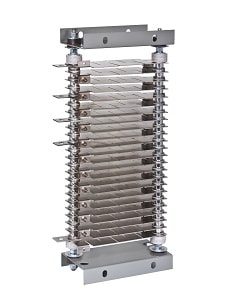
 [/vc_column_text][/vc_tab][vc_tab icon=”moon-stack-3″ title=”Stamped Grid” tab_id=”1402326708259-2-0″][vc_column_text]Generally used for low resistance and high current, grid resistors are made with punched steel sheet with holes at in each end for mounting. Grids are then stacked on insulated steel rods. Mica washers are inserted between grids for insulation, and the rods are mounted between steel end frames. To obtain the best electrical connection, we weld grids together.
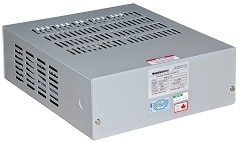
 [/vc_column_text][/vc_tab][/vc_tabs][/vc_accordion_tab][vc_accordion_tab icon=”moon-cube” title=”Enclosures”][vc_tabs style=”simple”][vc_tab icon=”moon-home-3″ title=”NEMA 1″ tab_id=”1402323063-1-23″][vc_column_text]Enclosures constructed for indoor use to provide a degree of protection to personnel against access to hazardous parts and to provide a degree of protection of the equipment inside the enclosure against ingress of solid foreign objects (falling dirt).
IP20
Protected against solid foreign objects of 12.5mm in diameter and greater. Not protected against water ingress.
 [/vc_column_text][/vc_tab][vc_tab icon=”moon-home-6″ title=”NEMA 3R” tab_id=”1402323063-2-54″][vc_column_text]Enclosures constructed for either indoor or outdoor use to provide a degree of protection to personnel against access to hazardous parts; to provide a degree of protection of the equipment inside the enclosure against ingress of solid foreign objects (falling dirt); to provide a degree of protection with respect to harmful effects on the equipment due to the ingress of water (rain , sleet, snow); and that will be undamaged by the external formation of ice on the enclosure.
IP23
Protected against solid foreign objects of 12.5mm in diameter and greater.
Water falling as a spray at any angle up to 60° from the vertical shall have no harmful effect.
 [/vc_column_text][/vc_tab][vc_tab icon=”moon-lock-3″ title=”NEMA 4″ tab_id=”1402325994361-2-3″][vc_column_text]Enclosures constructed for either indoor or outdoor use to provide a degree of protection to personnel against access to hazardous parts; to provide a degree of protection of the equipment inside the enclosure against ingress of solid foreign objects (falling dirt and windblown dust); to provide a degree of protection with respect to harmful effects on the equipment due to the ingress of water (rain, sleet, snow, splashing water, and hose directed water); and that will be undamaged by the external formation of ice on the enclosure.
IP56
Ingress of dust is not entirely prevented, but it must not enter in sufficient quantity to interfere with the satisfactory operation of the equipment; complete protection against contact.
Water projected in powerful jets (12.5mm nozzle) against the enclosure from any direction shall have no harmful effects.
 [/vc_column_text][/vc_tab][vc_tab icon=”moon-weather-rain” title=”NEMA 4X” tab_id=”1402326106104-3-8″][vc_column_text]Enclosures constructed for either indoor or outdoor use to provide a degree of protection to personnel against access to hazardous parts; to provide a degree of protection of the equipment inside the enclosure against ingress of solid foreign objects (windblown dust); to provide a degree of protection with respect to harmful effects on the equipment due to the ingress of water (rain, sleet, snow, splashing water, and hose directed water); that provides an additional level of protection against corrosion; and that will be undamaged by the external formation of ice on the enclosure.
IP56
Ingress of dust is not entirely prevented, but it must not enter in sufficient quantity to interfere with the satisfactory operation of the equipment; complete protection against contact.
Water projected in powerful jets (12.5mm nozzle) against the enclosure from any direction shall have no harmful effects.
[/vc_column_text][/vc_tab][/vc_tabs][/vc_accordion_tab][vc_accordion_tab icon=”moon-cube4″ title=”Enclosure Materials”][vc_tabs style=”simple”][vc_tab icon=”moon-paint-format-2″ title=”Galvanized Steel” tab_id=”1402323063-1-23″][vc_column_text]A protective coating of zinc is applied to steel. The zinc provides cathodic protection due to its greater negative electrochemical potential, making it the metal of preference to be consumed (when rusting). It often shows an aesthetic feature known as spangle, crystallites inside the coating. All of our galvanized steel material meets specific ASTM coating standards.
Once the galvanized steel is prepared, it is then treated for painting with a non-metallic iron phosphate coating. This heavily improves paint adhesion and increases corrosion protection if the metal’s paint film is broken. After the steel has been phosphatized, it is then powder coated. Powder coating cures in heat, forming a “skin”. This creates a harder finish, tougher than conventional paint.
Galvanized steel is a generally cost-effective and reliable material to prevent corrosion and damage to your product.

Stainless steel is touted for its resistance to corrosion and staining, and low maintenance needs. If your product will be used in an environment subject to corrosive conditions then we recommend using stainless steel over galvanized steel. The 304 grade steel provides greater resistance to corrosion than galvanized steel, and the 316 grade steel provides even more resistance than the 304.
Because stainless steel is comprised of chromium and nickel throughout the material itself, it provides corrosion resistance for a longer duration as it does not rely on a coating for protection. This leaves painting to be an an optional layer of protection. We generally use stainless steel with a natural finish unless otherwise specified.
If you need the high corrosion resistance paired with long-term usage, then consider stainless steel as a very viable alternative to galvanized steel.
 [/vc_column_text][/vc_tab][vc_tab icon=”moon-lab” title=”Anodized Aluminum” tab_id=”1402328923940-4-8″][vc_column_text]Anodizing is a process used to increase the thickness of a natural oxide layer formed on the surface of metal. Aluminum when exposed to any gas containing oxygen at room temperature will form a surface layer of amorphous aluminum oxide, which is very effective against corrosion.
We recommend anodized aluminum if you have specific corrosive conditions that are not or cannot be met by stainless steel. It is a very effective method of protecting against certain corrosive conditions.
 [/vc_column_text][/vc_tab][/vc_tabs][/vc_accordion_tab][/vc_accordions][/vc_column][vc_column width=”1/3″][mk_padding_divider size=”60″][mk_image src=”http://720.697.myftpupload.com/wp-content/uploads/2014/06/mcr-labeled.jpg” image_width=”300″ lightbox=”true” frame_style=”gray_border” desc=”An open Motor Control Resistor” caption_location=”outside-image” align=”center” animation=”scale-up” crop=”false”][/vc_column][/vc_row][vc_row css=”.vc_custom_1495569945197{padding-top: 20px !important;padding-bottom: 20px !important;background-position: 0 0 !important;background-repeat: repeat !important;}”][vc_column width=”1/2″][mk_fancy_title color=”#1e73be” size=”18″ margin_top=”10″ font_family=”none” animation=”left-to-right” width=”1/1″ el_position=”first last”]What are Motor Control Resistors?[/mk_fancy_title][vc_column_text]These resistors are used to control the torque and speed of AC and DC motors, along with limiting in-rush current. To avoid confusion it should be noted that these resistors are used to control energy input into motors while Dynamic Braking Resistors are used to brake and drain energy.
Motor Control Resistors are commonly used with wound-rotor motors as an external resistor circuit. Conductors in the rotor are connected to slip rings, these slip rings provide the contact to the resistor circuit. By changing the level of resistance in the circuit (the Motor Control Resistor), speed and torque can be adjusted. In other words, higher resistance means reduced torque and speed.
For multiple levels of torque and speed control, Motor Control Resistors use “steps” or “speeds”. Steps/speeds essentially provide intervals for levels of resistance. For most applications, a 4-step/5-speed Motor Control Resistor is recommended. 1-step/2-speed resistors are available, all the way up to 10-step/11-speed. In general we recommend that you use a higher number of steps if the motor is powerful and used for large-scale purposes such as mining. Usually there will always be one more speed level than resistor steps, because the maximum speed is achieved with all steps cut out; exceptions occur when a permanent slip resistor is required to reduce internal heating of the motor.
To enable manufacturers to test resistors under the same conditions, NEMA has created resistor classes based on duty and the type of application. We use these classes to conform to standards and making it easier for you to order your product. You can refer to the NEMA Resistor Applications table above, and then the NEMA Resistor Classes to help you determine the class for your motor.[/vc_column_text][mk_fancy_title color=”#1e73be” size=”18″ margin_top=”18″ margin_bottom=”18″ font_family=”none” animation=”left-to-right” width=”1/1″ el_position=”first last”]Advantages[/mk_fancy_title][vc_row_inner][vc_column_inner width=”1/2″ el_position=”first”][mk_custom_list style=”e26c” animation=”bottom-to-top” width=”1/1″ el_position=”first last”]
- Limit torque and speed of wound rotor motors to safe levels.
- Keep motor voltages within safe levels.
- Reduce overheating.
- Reduce wasted time during braking.
- Increase life of the equipment.
- Improved service reliability.
| Approximate Per Cent of Full-Load Current on First Point Starting from Rest | Duty Cycles | ||||||
|---|---|---|---|---|---|---|---|
| 5 Sec On 75 Sec Off | 10 Sec On 70 Sec Off | 15 Sec On 75 Sec Off | 15 Sec On 45 Sec Off | 15 Sec On 30 Sec Off | 15 Sec On 15 Sec Off | Continuous Duty | |
| 25 | 111 | 131 | 141 | 151 | 161 | 171 | 91 |
| 50 | 112 | 132 | 142 | 152 | 162 | 172 | 92 |
| 70 | 113 | 133 | 143 | 153 | 163 | 173 | 93 |
| 100 | 114 | 134 | 144 | 154 | 164 | 174 | 94 |
| 150 | 115 | 135 | 145 | 155 | 165 | 175 | 95 |
| 200 or over | 116 | 136 | 146 | 156 | 166 | 176 | 96 |
- Constant Pressure: 135-195
- Centrifugal: 133-193
Brick Plants
- Augers: 135
- Conveyors: 135
- Dry Pans: 135
- Pug Mills: 135
By-Products Coke Plants
- Reversing machines: 153
- Leveler ram: 153
- Pusher bar: 153
- Door machine: 153
Cement Mills
- Conveyors: 135
- Crushers: 145
- Rotary dryers: 145-195
- Elevators: 135
- Grinders, pulverizers: 135
- Kilns: 135-195
Coal and Ore Bridges
- Holding line: 162
- Closing line: 162
- Trolley: 163
- Bridge: 153
Coal Mines
- Car hauls: 162
- Conveyors: 135-155
- Cutters: 135
- Crushers: 134-193
- Fans: 134-193
- Hoists, slope: 172
- Vertical: 162
- Jigs: 135
- Picking tables: 135
- Rotary car dumpers: 153
- Shaker screens: 135
Compressors
- Constant speed: 135
- Varying speed, plunger type: 135-195
- Centrifugal: 93
- Bridge: 153
Concrete Mixers: 135
Cranes-General Purpose
- Hoist: 153
- Bridge, sleeve bearing: 153
- Trolley, sleeve-bearing: 153
- Bridge or trolley, roller-bearing: 152
Flour Mills: 135[/vc_column_text][/vc_column_inner][vc_column_inner width=”1/3″][vc_column_text]Line shafting: 135
Food Plants
- Dough mixers: 135
- Butter churns: 135
Hoists
- Winch: 153
- Mine slope: 172
- Mine vertical: 162
- Contractors’ hoists: 152
Larry Cars: 153
Lift Bridges: 152
Machine Tools
- Bending rolls, rev.: 163-164
- Non-rev.: 115
- Boring mills: 135
- Bulldozers: 135
- Drills: 115
- Gear cutters: 115
- Grinders: 135
- Hobbing machines: 115
- Lathes: 115
- Milling machines: 115
- Presses: 135
- Punches: 135
- Saws: 115
- Shapers: 115
Metal Mining
- Ball, rod, tube mills: 135
- Car dumpers, rotary: 153
- Converters, copper: 154
- Conveyors: 135
- Crushers: 145
- Tilting furnace: 153
Paper Mills
- Heaters: 135
- Calendars: 154-192
Pipe Working
- Cutting and threading: 135
- Expanding and flanging: 135-195
Power Plants
- Clinker grinders: 135
- Coal crushers: 135
- Conveyor, belt: 135
- Screw: 135
- Pulverized fuel feeders: 135
- Pulverizers, ball type: 135
- Centrifugal: 134
- Stokers: 135-193
Pumps
- Centrifugal: 134-193
- Plunger: 135-195
- Calenders: 155
- Crackers: 135
- Mixing mills: 135
- Washers: 135
Steel Mills
- Accumulators: 153
- Casting machines, pig: 153
- Charging machines, bridge: 153-163
- Peel: 153-163
- Trolley: 153-163
- Coiling machines: 135
- Conveyors: 135-155
- Converters, metal: 154
- Cranes, ladle, bridge, trolleys, sleeve-bearings: 153-163
- Roller-bearing: 152-162
- Hoist: 153-163
- Crushers: 145
- Furnace doors: 155
- Gas valves: 155
- Gas washers: 155
- Hot metal mixers: 163
- Ingot buggy: 153
- Kickoff: 153
- Levelers: 153
- Manipulator fingers: 153-163
- Side guards: 153-163
- Pickling machine: 153
- Pilers, slab: 153
- Racks: 153
- Reelers: 135
- Saws, hot or cold: 155
- Screwdowns: 153-163
- Shears: 155
- Shuffle bars: 155
- Slab buggy: 155
- Soaking pit covers: 155
- Straighteners: 153
- Tables, main roll: 155-163
- Shear approach: 155-163
- Lift: 155-163
- Roll: 155
- Transfer: 155
- Approach: 155
- Tilting furnace: 153
- Wire standing machine: 153
Woodworking Plants
- Boring machines: 115
- Lathe: 115
- Mortiser: 115
- Molder: 115
- Planers: 115
- Power trimmer and miter: 115
- Sanders: 115
- Saws: 115
- Shapers: 115
- Shingle machine: 115